
Catalytic gas cleaning
SCR for removal of NOx & CO/VOC
GEA is well known for its long-term proven application of Selective Catalytic Reduction (SCR) for NOx control.


GEA develops and manufactures highly efficient denitrification systems, tailor-made to customer needs. The SCR technology is the best available NOx removal (DeNOx) process, it selectively reduces NOx emissions by injecting Ammonia into the exhaust gas upstream of a catalyst.
Current and future requirements on NOx and VOC control are met with GEA’s advanced catalytic reduction technology. The high-activity catalyst and low-pressure drop result in a cost-effective NOx reduction.
Main Benefits
- Provide highest SCR performance efficiency with minimum ammonia slip
- Proven reliability over extended years of operation
- Reduced overall SCR pressure drop
- Ability to mitigate the catalyst´s poisoning and extend the life of catalyst
- No catalyst fouling thanks to optimized inlet temperature
- CAPEX and OPEX considerably lower than other DeNOX-Systems
Working Principle
Working Principle of SCR for NOx removal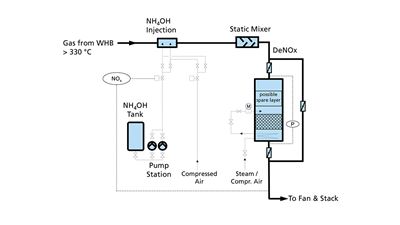
An aqueous ammonia solution or urea is injected through two-fluid nozzles (ammonia/compressed air) and into the ductwork upstream of the SCR where it immediately evaporates. The adequate mixing of ammonia is ensured by a static mixer installed in the ductwork downstream of the ammonia injection points. The gas and ammonia mixture enters the unit from the top and exits horizontally at the bottom.
A gas distribution system (swirl breaker) ensures an adequate gas distribution over the entire cross-section of the unit. The reaction between ammonia and NOX is enhanced by the presence of the catalyst bed, converting it into nitrogen (N2) and water. The catalyst is cleaned in an intermittent fashion (in 24-hour intervals), if required. The ammonia feed rate is controlled by the NOX outlet concentration of the gas.
The SCR in the glass industry is situated after the dedusting system and can also be installed in already existing plants.
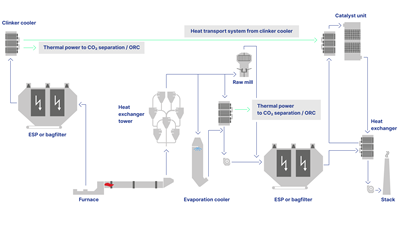
GEA offers the SCR for cement plants in low-dust arrangement, situated after the bag filter or electrostatic precipitator.
As the temperature after dedusting can be quite low, a gas-gas-heater is required (recuperative or regenerative) to preheat the gas.
The temperature needs to be further heated up to the temperature required for the DeNox-catalyst. This can be achieved either by an internal heat source from preheater waste gas or clinker cooler waste gas or by an external heat source such as a natural gas burner.
Downloads
Related Products
Catalytic ceramic candle filter (BisCat)
BisCat ceramic filters with an embedded catalyst matrix consists of vanadium pentoxide, allow for the removal of particulates, sorption processes for acidic gases, reduction of NOX and the decomposing of dioxins, VOC`s. The filter elements are chemically inert and corrosion resistant. Gas cleaning in one step. A multifunctional filter for the sim...

Bagfilter (ECOpuls)
Bagfilters are the technology of choice in many cases when low dust content is needed for gas cleaning. Their ability to remove large Ioads on a non-selective basis has made them important for many applications.
GEA Insights India
All pharmaceutical freeze-drying vials are the same! Aren't they?
Whether it’s a fad or the future, 100% vial traceability is becoming an increasingly important consideration in the pharmaceutical freeze drying industry. Keeping a close eye on developments is GEA. We’re investigating possible solutions and, what’s more, we have the experience, expertise and know-how to implement them.

Alcohol-free beer: They want it all – they want less
There was a time when the phrases ‘non-alcoholic beer’ and ‘tastes good’ were seldom used together in the same sentence, particularly by consumers. But low-proof and alcohol-free beers have come a long way – many of them now refreshing drinks in their own right – thanks in no small part to technology from GEA.

Innovating patient care with aseptic spray drying
At GEA, our commitment to engineering for a better world fuels our pursuit of innovative solutions that enhance patient care and safety. One of our most promising ventures in recent years is aseptic spray drying – a technology that promises to revolutionize pharmaceutical manufacturing.
