
UHT Plants
We offer three different types of UHT Plants for Aseptic Product Treatment
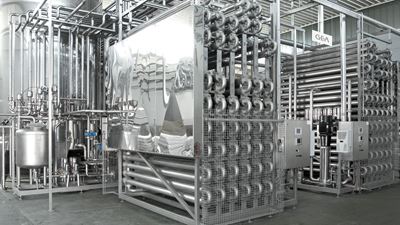
It is your choice which UHT Plant you choose
GEA markets three different types of UHT Plant - depending on the product to be treated, the product quality and efficiency:
UHT Plant, Type I
These product treatment plant work according to the indirect heating principle. Their great benefit: Using this method, the UHT Plant Type I provides very high production safety. This process technology has proved successful for many years. The UHT Plant have optimized flow conditions which produce good product quality and high efficiency with a heat recovery of up to 90%.
UHT Plant, Type P
Similar to the indirect UHT Plant Type I, the UHT Plant Type P is widely based on identical process technology.
The difference is that the tubular heat exchanger type P is used here – indirect heat transfer between the product to be heated and that to be cooled is not applied. The advantage is that this plant type achieves an even higher efficiency and improved product quality without the need to expand the heat exchange surface.
UHT Plant, Type D
The direct heating method used in these UHT Plant offers the advantage of very high product quality. The integral steam injector and a flash cooler provide very short dwelling times in the temperature intensive zones.
Downloads

Related Videos
GEA UHT Direct Infusion
GEA UHT Indirect
GEA Insights India

All pharmaceutical freeze-drying vials are the same! Aren't they?
Whether it’s a fad or the future, 100% vial traceability is becoming an increasingly important consideration in the pharmaceutical freeze drying industry. Keeping a close eye on developments is GEA. We’re investigating possible solutions and, what’s more, we have the experience, expertise and know-how to implement them.

Alcohol-free beer: They want it all – they want less
There was a time when the phrases ‘non-alcoholic beer’ and ‘tastes good’ were seldom used together in the same sentence, particularly by consumers. But low-proof and alcohol-free beers have come a long way – many of them now refreshing drinks in their own right – thanks in no small part to technology from GEA.

Innovating patient care with aseptic spray drying
At GEA, our commitment to engineering for a better world fuels our pursuit of innovative solutions that enhance patient care and safety. One of our most promising ventures in recent years is aseptic spray drying – a technology that promises to revolutionize pharmaceutical manufacturing.
