
Liquid Dosage
E.Coli
From oral vaccines to immune-modulators and offering a broad range of applications in biotechnology and pharmaceutical research, development and analysis, bacterial lysates are widely used in the life science industries. Different methods can be used to prepare cell lysates from Escherichia coli (E. coli) cells, for example, including sonication, homogenization, enzymatic lysis and freezing/grinding.
Homogenizers, however, are the most commonly used devices to lyse large quantities of bacteria. A cell suspension is pumped through the minute orifice of a homogenizing valve at high pressure; this is followed by the sudden release of the pressure on the suspension, resulting in an instant expansion that provides the turbulence and liquid shear — combined with the high pressure — that breaks the cells.
The main disruptive factor in this process is the pressure applied to the sample and the subsequent pressure drop across the valve. This provides the impact and the shear stress, making the cells break in proportion to the operating pressure.
Compared with other methods, homogenization is both convenient and efficient, offering higher percentage cell disruption rates. Modern GEA homogenizers are able to work continuously, enabling large quantities of cells to be processed at high operational pressures, which eliminates the need to add deoxyribonuclease (DNase) to the cell suspension.
Suggested pressures for typical applications are 600–1000 bar with a single stage homogenizer; multiple passes (2–3) are generally required to achieve adequate lysis. It should be noted that high processing pressures result in a rise in operating temperatures. Cells should, therefore, be cooled (4 °C) prior to use to avoid inactivating proteins by foaming.
Fermenters, separators, decanters and cross-flow filtration technology for the gentle treatment of fragile cell cultures are also available from GEA. We understand that the careful treatment of living micro-organisms, sterility and efficiency are prerequisites to economical, reliable and efficient processing.
Produits et technologies
Affichage de 4 sur 9
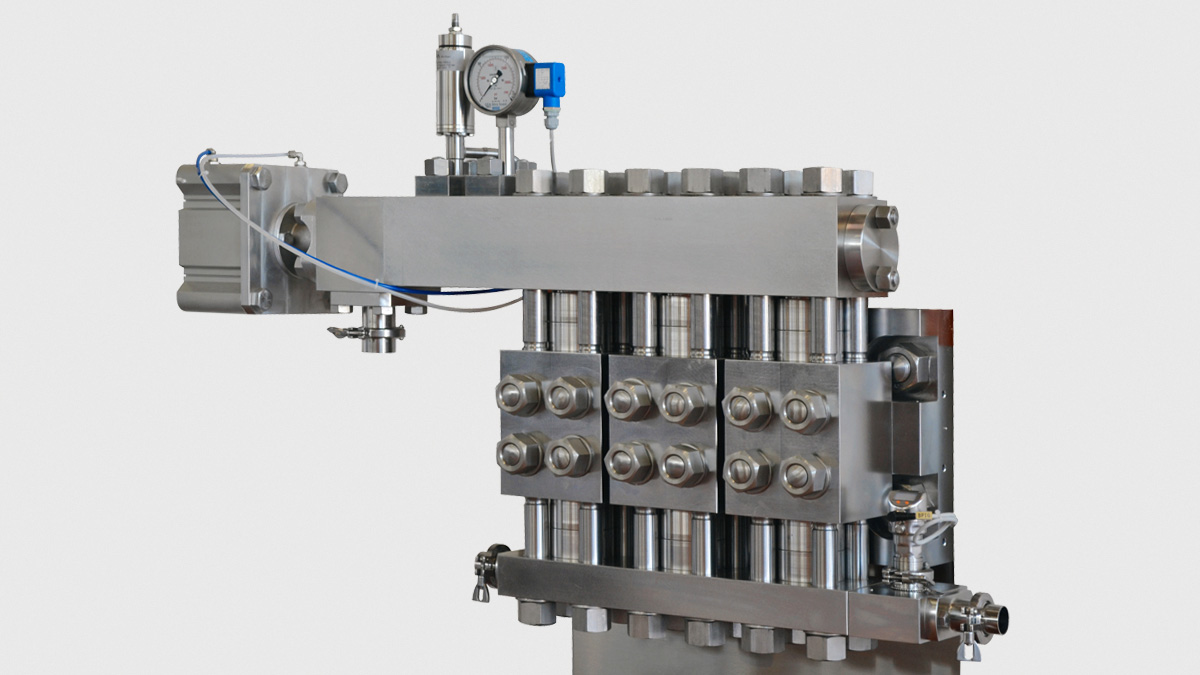
Bloc de compression pour homogénéisateur
Les têtes de compression de GEA constituent le cœur des homogénéisateurs, car elles activent le processus d'homogénéisation en pompant le produit à haute pression jusqu'à ce qu'il s'écoule dans la vanne d'homogénéisation.
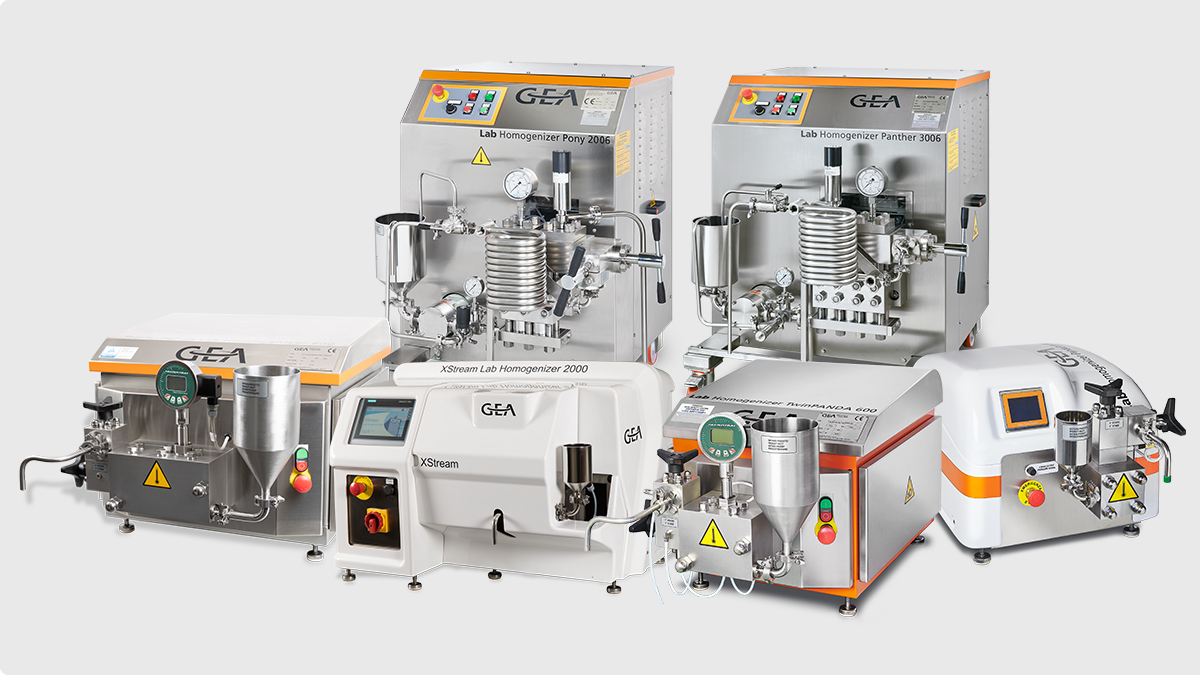
Homogénéisateurs de laboratoire
Les homogénéisateurs de laboratoire de GEA sont de petite taille et compacts. Ils permettent de tester les effets de l'homogénéisation sur le produit et d'évaluer les meilleurs paramètres de process.

Homogénéisateurs industriels
Les homogénéisateurs industriels de GEA sont constitués de deux éléments essentiels : un bloc de compression, qui permet de pomper le produit à haute pression, et une vanne d'homogénéisation qui micronise les particules dispersées de l'ordre des micromètres et des nanomètres, selon les caractéristiques du produit à obtenir et selon les résultats ...

Homogénéisateurs sur skid
Depuis quelques temps, GEA a poussé plus loin les limites des unités d'homogénéisation à très haute pression (THP) pour les applications pharmaceutiques et biotechnologiques. Notre gamme compte des machines de laboratoire pour banc de travail, pour la conception et la fabrication interne de prototypes, mais aussi des systèmes de production m...
Downloads
GEA Insights

All pharmaceutical freeze-drying vials are the same! Aren't they?
Whether it’s a fad or the future, 100% vial traceability is becoming an increasingly important consideration in the pharmaceutical freeze drying industry. Keeping a close eye on developments is GEA. We’re investigating possible solutions and, what’s more, we have the experience, expertise and know-how to implement them.

Bière sans alcool : Ils en veulent tous – avec moins
Autrefois les expressions « bière sans alcool » et « c’est bon » étaient rarement utilisées ensemble dans la même phrase, en particulier par les consommateurs. Mais depuis les bières à faible teneur en alcool et sans alcool ont fait bien du chemin et nombreuses d’entre elles ont désormais accédé au rang de boissons rafraîchissantes à part entière, et ce, en grande partie grâce à la technologie de GEA.

Innovating patient care with aseptic spray drying
At GEA, our commitment to engineering for a better world fuels our pursuit of innovative solutions that enhance patient care and safety. One of our most promising ventures in recent years is aseptic spray drying – a technology that promises to revolutionize pharmaceutical manufacturing.
